




Thank you to my physics teacher, Mrs. Key, for all the information I have learned this school year. It has allowed myself to grow as an individual and accomplish goals.

Table of Contents:
The 3 States of Matter.......................Page 3
Solids...................................................Page 4-5
Liquids.................................................Page 6-7
Gases...................................................Page 8-9
History.................................................Page 10
State changes.....................................Page 11-16
Importace of States of Matter..........Page 17
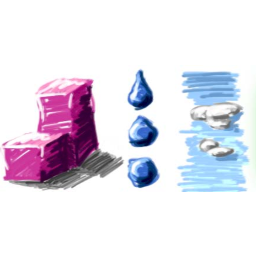
Solids, liquids, and gas are the 3 states of matter. These states of matter describe the physical property of an object. Each of these states of matter are also called a phase.
What are states of matter?

Solids:
Solids have a definite shape. This means that they do not need a container to give them a shape. Solids are also going to have volume, meaning that are going to take up the same amount of space anywhere.


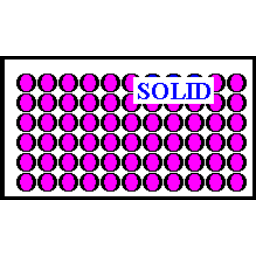
Particles of a solid:
The particles that make a solid are packed very close together. The particles slightly vibrate and move back and forth.

Liquids do not have a definite shape. They are going to take the shape of the container which placed in. Liquids are also going to have volume like solids. Meaning that the liquid is going to take up the same amount of space in any container it is placed in.
Liquids:


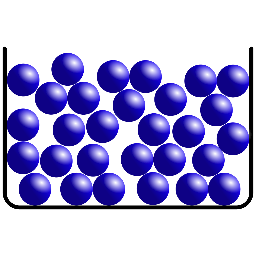
Particles of a liquid:
The particles of a liquid are packed almost like a solid but have more room to move around. It's like a group of marbles in a container.

Gases are like liquids and do not have a definite shape but take the shape of the container. Unlike solids and liquids, gases do not have volume but spread out to fill the entire container it is in.
Gases:


Particles of a gas:
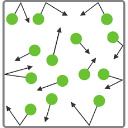
The gas particles move freely in all directions and at high speeds.

Ancient Greeks originally suggested that all matter is made up of tiny particles.
Robert Brown observed under a microscope the random motion of water.
Albert Einstein helped explain this observation and suggested the motion was a result of thermal motion of the liquid molecules.
HISTORY:

- Full access to our public library
- Save favorite books
- Interact with authors

- < BEGINNING
- END >
-
DOWNLOAD
-
LIKE
-
COMMENT()
-
SHARE
-
SAVE
-
BUY THIS BOOK
(from $3.19+) -
BUY THIS BOOK
(from $3.19+) - DOWNLOAD
- LIKE
- COMMENT ()
- SHARE
- SAVE
- Report
-
BUY
-
LIKE
-
COMMENT()
-
SHARE
- Excessive Violence
- Harassment
- Offensive Pictures
- Spelling & Grammar Errors
- Unfinished
- Other Problem

COMMENTS
Click 'X' to report any negative comments. Thanks!