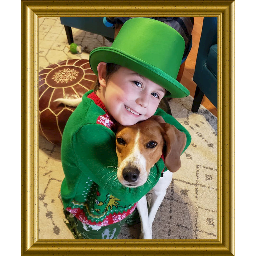
on his seventh
birthday
From Grandpa
Jamieson

Introduction
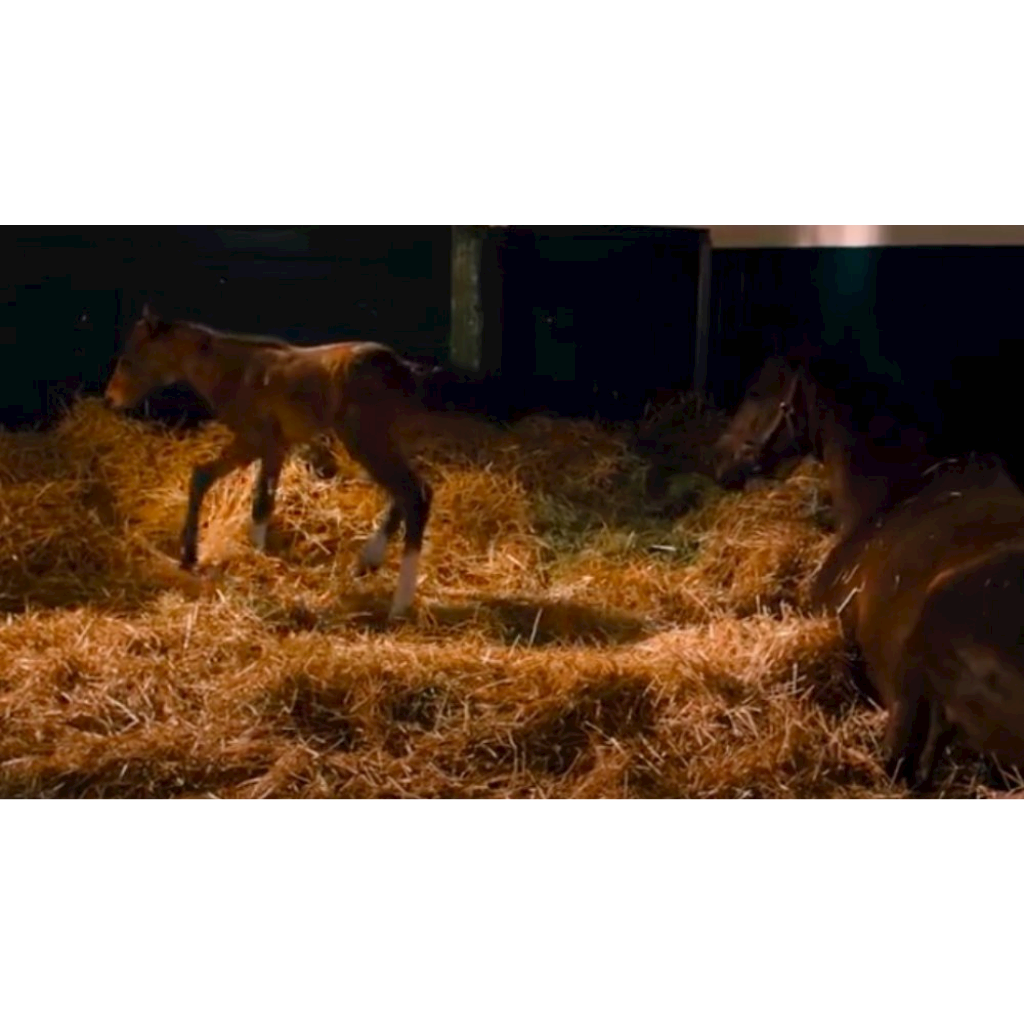
At precisely ten minutes after midnight on the morning of March 30, 1970, a small chestnut colt was born in Caroline County, Virginia, in a small foaling shed at a place called The Meadow. No one was particularly impressed at the time, but this young colt was destined to become the greatest race horse that ever lived.
The colt was quickly dubbed Red because of his chestnut coat. As he grew, people began to call him Big Red because of his size, and to those who new him best - owner Penny Tweedy, trainer Lucien Laurin, jockey Ron Turcotte, groom Eddie Sweat, and exercise rider Charlie Davis - he was always known either as Red or Big Red. But to the racing world, which requires that every horse have a unique name, he would be known as Secretariat.
Building the Winning Team
Penny Tweedy was usually referred to as Penny Chenery, her maiden name, because her father, Christopher Chenery, was so well-known in horse racing circles. He was the founder of The Meadow, the Chenery family's stable, where Penny and her brother Hollis grew up. The Meadow had been successful over the years, but the stable had fallen on hard times after Penny's mother died and her father became ill.
Penny, who had been living as a housewife in Denver with her husband and children, returned to The Meadow to put things in order. One of the first things that she had to do was to fire the stable's trainer, who had been arranging to sell some of the stable's best horses to a competing stable for about half of what they were worth. Had he done so, the stable would not have been able to survive.
Penny's brother Hollis wanted to sell the stable, but Penny did not. It was in deep financial trouble, but Penny believed that it could be saved, and she had a somewhat risky plan to save it. She wanted to breed a superhorse.
Ogden Phipps was a wealthy stockbroker, Hall of Fame tennis champion, art collector, philanthropist, thoroughbred horse racing executive, and - most importantly for our story - a breeder of race horses. He owned a stallion (a male horse) named Bold Ruler and wanted to breed it with two mares (female horses) owned by The Meadow, one named Somethingroyal and the other Hasty Matilda. He offered Penny a deal. Bold Ruler would be bred to both mares and they would flip a coin to determine who would get the foal (baby horse) born to each one. Penny agreed and a date was set for the coin toss.
There are two types of thoroughbred race horses: speed horses and distance horses. Some have great speed, but cannot keep it up for long. Others are not quite as fast, but have great stamina. Speed horses have an advantage in short races, but distance horses are more likely to win the longer ones. The trick is to get the right mix of both.
Bold Ruler was a speed horse. So was Hasty Matilda, but Somethingroyal was a distance horse. Both Phipps and Penny knew that, but they also knew that Hasty Matilda was quite a bit younger than Somethingroyal, and that also makes a difference. Penny wanted to combine Bold Ruler's speed with Somethingroyal's endurance. That was risky because of Somethingroyal's age, so she was pretty sure that Phipps would choose Hasty Matilda. If so, Penny would get what she wanted no matter who won the coin toss. As it turned out, Phipps won the toss and - as Penny had anticipated - chose Hasty Matilda, so they both got what they wanted.
So the deal was set. The sire (father) of Penny's horse would be the speed horse Bold Ruler and its dam (mother) would be the distance horse Somethingroyal. If things went as planned, this would result in a horse with lots of speed and enough stamina to win the longer races. Penny crossed her fingers for luck.
The three most important races of all are the Kentucky Derby, the Preakness, and the Belmont Stakes. If a horse wins all three, he or she is said to have won the Triple Crown, which is a big deal. It had not been done since Citation did it way back in 1948. It's hard to do because all three races are fairly long, but the Belmont is so long that it is almost impossible for a speed horse to win. That's why there are so few Triple Crown winners. But that is precisely what Penny was aiming to do. If she were to succeed, she believed that she could win them all and save The Meadow. You might say that Penny was an optimist.
The next thing that Penny would need was a trainer to replace the one that she had fired, so she sought advice from a trusted family friend named Arthur "Bull" Hancock. He was a breeder of race horses and the owner of Claiborne Farm in Paris, Kentucky. When she told him what kind of a trainer she was looking for, he recommended a recently retired French Canadian trainer named Lucien Laurin.
Penny found Lucien on a driving range, not adjusting very well to retirement. At first, he turned her down, telling her that he was done with horse racing. But after learning about Penny's plan to breed Bold Ruler with Somethingroyal, Lucien changed his mind and told her to call him when the colt was born. And that's exactly what she did. Now Penny had both a horse and a trainer. She also had a groom (Eddie Sweat) and an exercise rider (Charlie Davis) who already worked for The Meadow. The winning team was coming together.
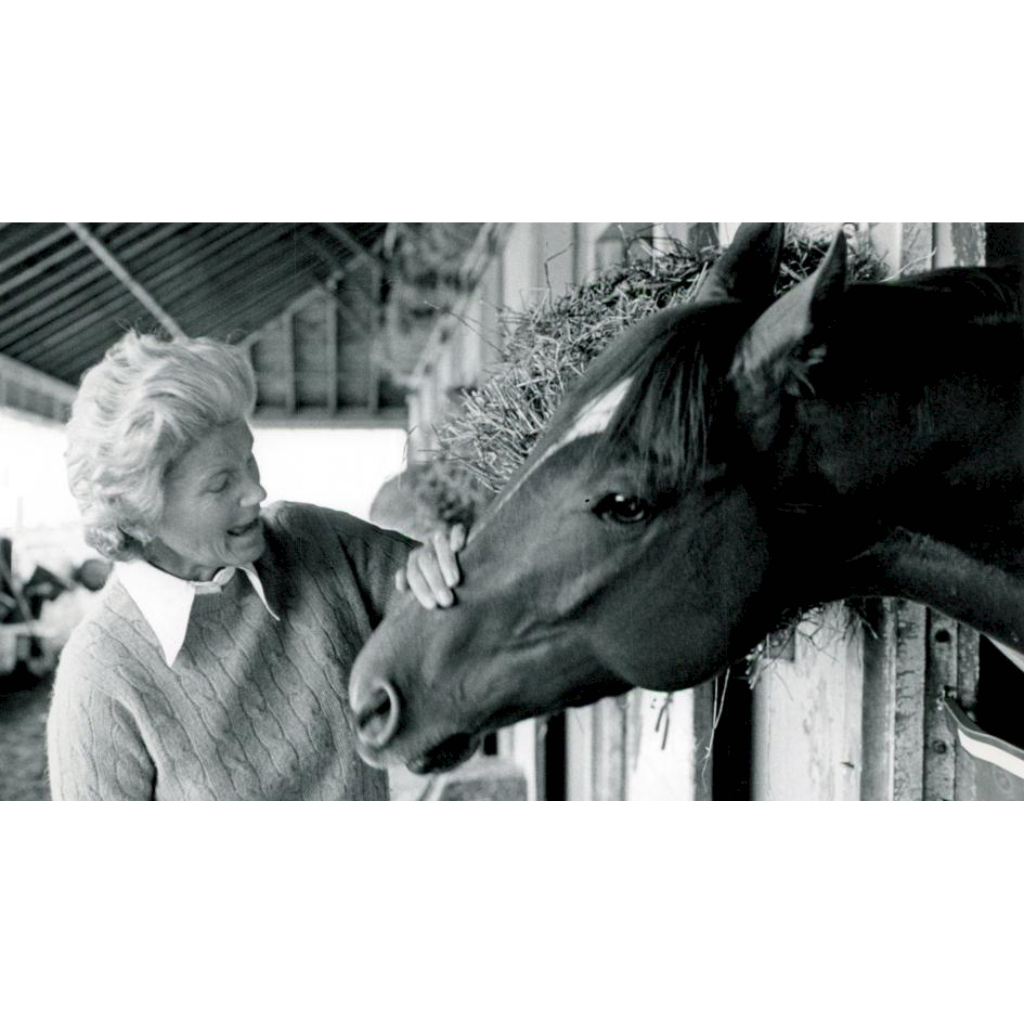
Penny Chenery with Big Red
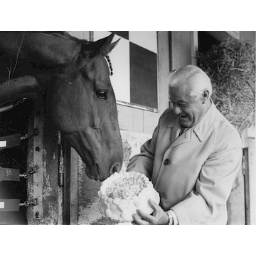
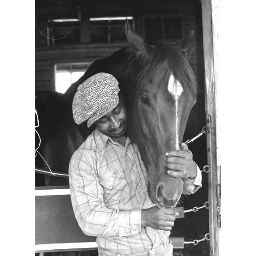
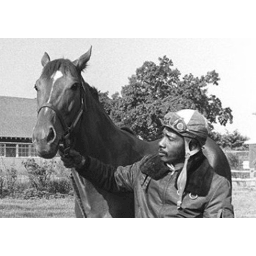
Top, left: Trainer Lucien Laurin
Top, right: Groom Eddie Sweat
Bottom: Exercise rider Charlie Davis
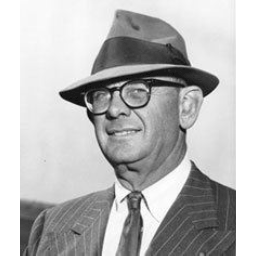
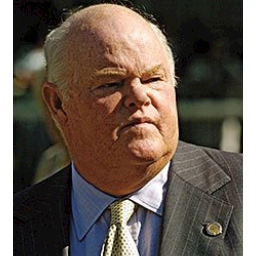
Left: Ogden Phipps, the man who proposed the coin toss that decided who would get the first pick of the two foals sired by Bold Ruler.
Right: Arthur "Bull" Hancock, a family friend and the owner of Claiborne Farm in Kentucky. He was the man who recommended Lucien Lauren to Penny Chenery.
A Short Primer on Horse Racing
Before we go on to discuss Big Red’s racing career, let’s take a few minutes to learn some of the terminology and practices found in horse racing.
A newborn horse is called a foal. A young male horse is a colt and a young female horse is a filly. An older male horse is a stallion and an older female horse is a mare. A father horse is a sire and a mother horse is a dam. There are also grandsires, granddams, etc.
The groom is the person responsible for taking care of a horse. The groom provides the horse with food, water, and medicine, grooms the horse, keeps the stable clean, etc. No one spends more time with a horse than the groom.
The trainer is the person responsible for teaching a horse everything it needs to know to successfully compete in a horse race. Every horse is different, so the trainer has to customize the training to get the best performance out of each horse.
The jockey is the person who rides the horse in a race. Since a horse will tend to be slower if it has to carry a lot of weight, most jockeys tend to be very short, thin, and light. A good jockey can make a big difference in a race, especially if he is familiar with a particular horse’s running style. The best jockeys tend to get the best horses, since their owners want to win the most important races where the competition is the toughest. When a top horse and a top jockey are able to work together as a well-oiled machine, they can be almost unbeatable.
In horse racing parlance, if you come in first, you win. If you come in second,
you place. And if you come in third, you show. The terms “also ran” and "out of the money" are used to refer to the horses that don't win, place, or show.
Big Red was a thoroughbred. The breed originated in Arabia, where they were bred mainly for their agility, speed, and spirit. All modern thoroughbreds are descended from three Arabian stallions imported to England in the 17th and 18th centuries. The breed was brought to America from England around 1730 and careful records have been kept of their pedigrees right down to modern times.
All thoroughbred horses must be registered under a unique name before they are allowed to race. Since most of the obvious names have already been used, it can be a challenge to come up with a new one. Big Red’s official name was Secretariat, and he was the only thoroughbred race horse who ever did or ever will have that name.
Distances on a race track are measured in furlongs. A furlong is an eighth of a mile, which is 220 yards or 660 feet. Distances between horses are measured in lengths, meaning the length of a horse, so it is easy to understand what it means if a horse is said to have won a race by, say, three-and-a-half lengths. In closer races, a horse might be said to have won by a nose or a head or a neck.
Some horse races are run on turf (grass), but most are run on dirt tracks. The tracks are oval in shape and the horses run in a counter-clockwise direction. They begin the race from a metal starting gate, which is quickly removed once the horses are sprung free of it, and then the race is on. On the following page, you will see a diagram of a generic race track. There are poles marking the distance in furlongs from the finish line. Sections of the track have names as well, like the clubhouse turn, the backstretch, the far turn, and the homestretch.
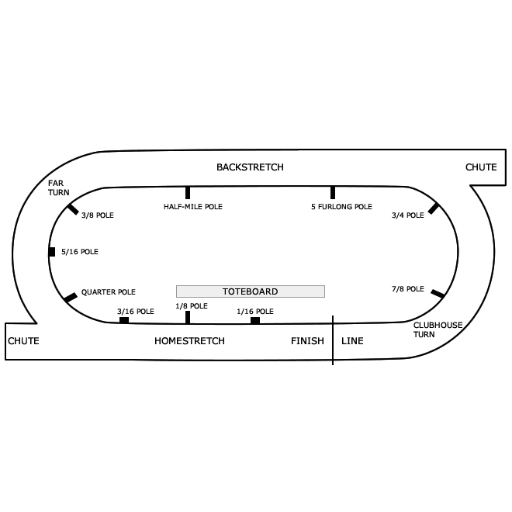
There are three main types of races for thoroughbreds - maiden races, allowance races, and stakes races. Maiden races are the least competitive. They are for horses who are just beginning their racing careers and for those who are just not good enough to move up to the next level.
There are two classes of maiden races, maiden special weight races for top quality horses like Big Red and maiden claiming races for those who aren't believed to be good enough to start out at a higher level. In a claiming race, the horses are for sale. A buyer must claim the horse before the race, but the seller gets the purse (prize money) if the horse wins. The buyer becomes the new owner, even if the horse falls down and dies in the middle of the race!
Allowance races are the next step up. These horses are not for sale and the purses are bigger. They are called allowance races because each horse must carry a certain amount of weight, with some allowed to carry less to make the race more competitive.
The top level of races are called stakes races. They're only open to the very best horses and the purses are often very large. The Triple Crown races are all stakes races.
Betting is allowed at thoroughbred race tracks, and bettors usually look at a horse's record before placing their bets. They can bet on any horse in the race to win, place, or show. A win ticket only pays off if the chosen horse wins, a place ticket pays off if the horse wins or places, and a show ticket pays off if the horse wins, places, or shows.
The odds are determined by how much money is bet on each horse. A lot of money is bet on the "favorite" (the horse who is expected to win) and very little on the "long shots" (the ones expected to lose and to be "out of the money"). In most cases, the favorite wins only about one out of three races and may only pay 10 or 20 cents on a two dollar bet. The long shots often pay out large amounts when they win, but they don't win very often. In other words, it is very hard to come out ahead at the race track, so most people expect to lose money and just bet for the fun of it. Some people, though, take it very seriously and might be willing to cheat in order to win.
What would happen, for example, if a very good horse were to be entered into a race under the name of a horse with a long record of losses? Anyone who knew about it could bet on this apparent long shot and make a lot of money.
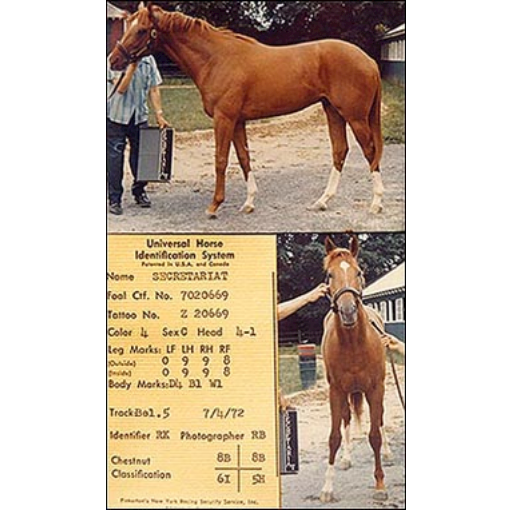
To prevent this from happening, careful identification records are maintained for all thoroughbred race horses, including photographs. Here are some of Secretariat's identification records. Note the three white "stockings" on the lower legs, as well as the white "star" and thin white line on his face.
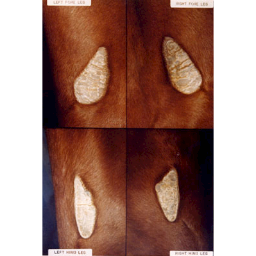
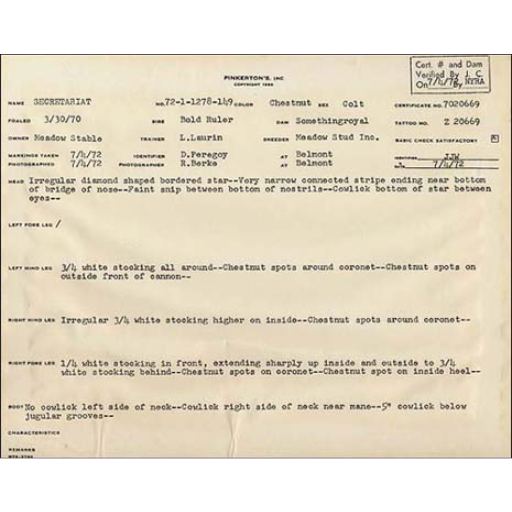
Here are a few more photographs and written descriptions of Secretariat that were a part of his identification records. As you can see, they are very detailed, making it almost impossible to substitute one horse for another in a race.
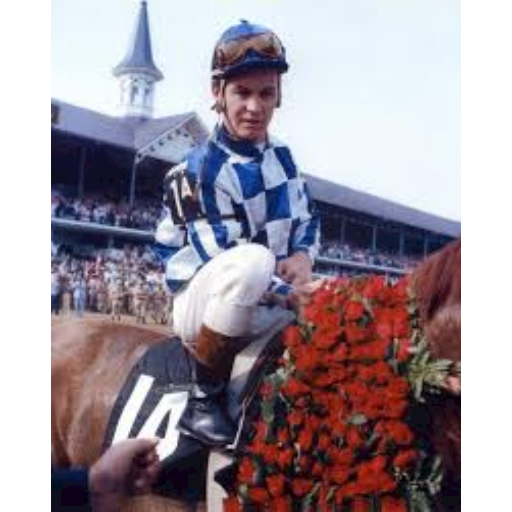
Finally, every stable has its own distinctive riding silks, the shirts that are worn by all jockeys riding for that stable.
The Meadow's jockeys wore a checkerboard pattern in blue and white, as seen in this photograph of Ron Turcotte in the winner's circle at Churchill Downs. It was taken following Secretariat's win in the 1973 Kentucky Derby.
Secretariat as a Two-Year-Old
Race horses all have the same official birthday: January 1 of the year in which they are born. Since Big Red was born on March 30, 1970, his official birthday was January 1, 1970. Since horses mature a lot faster than people do, they are ready to start racing as two-year-olds and reach the peak of their ability as three-year-olds. They can continue racing after that, but the most important races - including the Triple Crown races - are open only to three-year-olds.
Penny wanted to start racing Big Red as a two-year-old, but first she would need two things: an official name and a jockey. She gave the job of finding a name to Elizabeth Ham, The Meadow's long-time secretary. The first set of names she submitted to the Jockey Club - Sceptre, Royal Line, and Something Special - were all rejected. The second
set included Games of Chance, Deo Volente (Latin for "God Willing"), and Secretariat. The last name was accepted and Big Red became Secretariat. And, for the remainder of this book, that's what we will call him.
The job of finding a jockey was given to Lucien Laurin. He recommended another French Canadian named Ron Turcotte, who was the top jockey in Canada at the time.
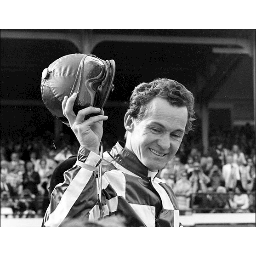
Unfortunately, Ron (pictured at right) had been injured in a race and was using crutches, so he would not be available for Secretariat's maiden race. Instead, a jockey named Paul Feliciano was selected to introduce Secretariat to the racing world.
Penny entered Secretariat in an Independence Day race at Aqueduct Race Course in New York City. It was a short race, just five-and-a-half furlongs, so the twelve horses in the race would have to run at top speed from start to finish. Secretariat got boxed in early in the race, but when he got free he bolted forward, charging from far behind with amazing speed into the homestretch. Nevertheless, he finished fourth - the only time in his racing career that he would be an "also ran" - but he drew a lot of attention with that furious late charge.
Secretariat's second race, also with Paul Feliciano aboard, was run eleven days later at the same track. This time he was a strong betting favorite and he won easily, beating the second place horse by four lengths. The racing world took notice and there was excitement in the air. Everyone agreed that it was time for this promising young chestnut colt to move up into faster company. And Ron Turcotte would be his jockey.
Secretariat's next race was at Saratoga Race Course in Saratoga Springs, New York. This was an allowance race, open only to horses that had already won a race, and was run on July 31, 1972. Secretariat's abilities were no secret to race fans and he was a heavy favorite to win. He did not disappoint them, winning easily and setting the stage for his next move up in class. His next race, and every race for the rest of his career, would be a stakes race.
Secretariat ran two more races at Saratoga - the Sanford Stakes and the Hopeful Stakes - in August, and won both handily. Ron was beginning to see that Secretariat had a mind of his own and a keen sense of what was needed to win. He normally started out trailing the pack, perhaps remembering how he had gotten boxed in early in his first maiden race. Ron never had to tell Secretariat when to turn on the speed and never held him back when he decided to run. Ron was just a passenger.
The next stop was Belmont Park in New Yok City, where Secretariat ran in two races with big purses - the Futurity Stakes and the Champagne Stakes. In the Futurity, he ran in the style that Ron had come to expect, starting at the end of the pack and then moving up steadily on the outside to win. Stop the Music finished second.
In the Champagne Stakes, Secretariat finished first, two lengths ahead of Stop the Music. However, he was disqualified and placed second because he had bumped into Stop the Music in the homestretch. That's not allowed in thoroughbred racing. The horses don't know that, of course, so it's up to the jockeys to keep it from happening.
Secretariat and Stop the Music met again in the Laurel Futurity at Laurel Race Course in Laurel, Maryland. Ron was careful to avoid any contact with the other horses, giving them a wide berth on a muddy track. He won handily by eight lengths.
And that was it for Secretariat's two-year-old racing season, but the racing world was agog. He was named Horse of the Year, a rare honor for a two-year-old, especially in a year when Riva Ridge, a three-year-old stable mate at The Meadow almost won the Triple Crown. Riva Ridge won the Kentucky Derby and the Belmont, but finished fourth in the Preakness on a muddy track.
Some horses - often referred to as "mudders" - run well on muddy tracks. Others have trouble getting their footing, slipping and sliding all over the place. Riva Ridge was not a mudder and it cost him the Triple Crown. However, his winning ways helped to keep The Meadow financially afloat in a very tough year. But it was about to get much tougher. When Penny's father, the owner of The Meadow, died in December 1972, she and her brother Hollis inherited the stable - along with an inheritance tax of six million dollars. And they didn't have the money to pay the taxman.
Hollis wanted to sell The Meadow to raise the money to pay the inheritance tax, but Penny did not. As it turned out, her father had left the matter of the horses entirely up to her, so even if The Meadow was sold, she could keep the horses. Since they were far more valuable than the stable itself, Hollis would have to go along with Penny's plan.
Ogden Phipps, the coin toss guy, offered Penny eight million dollars for Secretariat, but she turned him down flat. Penny figured that a lot of wealthy people would be willing to hitch their fortunes to a shining star called Secretariat, so she offered to sell shares of her wonder horse for $190,000 dollars each. There were a lot of takers - including Phipps - and she raised enough money to pay the tax. That saved The Meadow, but she also had to agree that Secretariat would only race one more year, as a three-year-old. The hope was that he would win the Triple Crown and then be put to the task of siring more race horses. In horse racing, that's where the real money is.
Secretariat as a Three-Year-Old
Secretariat spent the winter resting and training for his big year as a three-year-old. Because of the deal that Penny had struck when she sold those shares in Secretariat, this would be his last year of racing, so it was do-or-die time. The three biggest races of all - the Kentucky Derby, the Preakness Stakes, and the Belmont Stakes - were open only to three-year-olds and Penny was confident that Secretariat could win them all. That would make him the first Triple Crown winner since Citation in 1948.
In the spring, Penny entered Secretariat in three prep races to get him into racing form for the Triple Crown. The first of these was the Bay Shore Stakes, which was run at Aqueduct Race Course in New York City on March 17. It was a seven furlong race and Secretariat won it by a little more than four lengths. Secretariat loved to run and
showed it by running at full speed for another furlong. Finally, Ron reined him in and they proceeded to the winner's circle. On his way there, he noticed that one of the other jockeys had lodged an objection, claiming that his horse had been bumped by Secretariat. But after interviewing both jockeys and reviewing the tape, the track stewards rejected the claim and declared Secretariat the winner.
On April 7, Secretariat ran again in a slightly longer race, the one mile Gotham Stakes, also at Aqueduct. Secretariat breezed to a win, tying the track record and coming within one and one-fifth of a second of breaking the world record for the mile. And this time he led the pack from start to finish, which was unusual for Secretariat. His performance in this race set the racing world abuzz and even people who normally didn't follow horse racing were beginning to take notice. It appeared to almost everyone that Secretariat was destined to win the Triple Crown.
There was only one more prep race before the Kentucky Derby, the Wood Memorial. It was run at Aqueduct on April 21 on a mile-and-an-eighth course, just an eighth of a mile shorter than the Derby. For the first time, Secretariat would race against Sham, the horse that would become his main competitor for the Triple Crown. In this race, Sham came in second. First place went to - surprise! - a horse named Angle Light. Secretariat finished third.
As you can imagine, Penny, Lucien, and Ron were deeply concerned. So were all of the people who had bought those expensive shares in Secretariat. Race fans were shocked at this turn of events. What, everyone wondered, could have gone wrong?
As it turned out, Secretariat had developed an abscess inside his mouth that must have caused a great deal of discomfort, and it was assumed that this impaired his ability to run his usual race. Medical attention solved the problem and everyone
crossed their fingers for luck. The Derby was just two weeks away and both Sham and Angle Light would be there to challenge Secretariat.
May 5 was the big day. Thirteen horses would compete in the Kentucky Derby, which is often referred to as "The Run for the Roses." The Derby, as always, would be run at Churchill Downs in Louisville, Kentucky on a one and a quarter mile course. 135,000 fans came to see the great Secretariat, crowding into the grandstand beneath the track's famous twin spires and sprawling out across the infield. They came to see Secretariat win and they did not want to be disappointed.
The horses were loaded into the starting gate, the doors were sprung open, and they were off. Secretariat let the speed horses bolt to the front, leaving him in eleventh place. The Derby is a long race and many a great horse begins this way, passing
one horse at a time on the way to victory. Secretariat ran to the outside of the pack, where he would not be in a crowd and could not be boxed in. He would have to run a longer distance on the turns, but he knew that he had the speed and the stamina to do it. Ron just let him run his own race, because he knew that Secretariat loved to run and wanted to win. In the homestretch, Secretariat caught up to the leader - Sham - and they battled for the win, their hooves pounding down the stretch at a blistering pace.
Secretariat eventually pulled ahead and crossed the finish line first, setting a new track record and a new Kentucky Derby record: 1:59.4. He was the first horse ever to run the Derby in under two minutes and, as of this writing, his Derby record still stands. Even more remarkable is the fact that Sham, in finishing second, also broke the old Derby record. But Sham was not finished with Secretariat yet. They would compete again in two more Triple Crown races. And what a competition it would be!
Secretariat winning the Kentucky Derby in record time with jockey Ron Turcotte
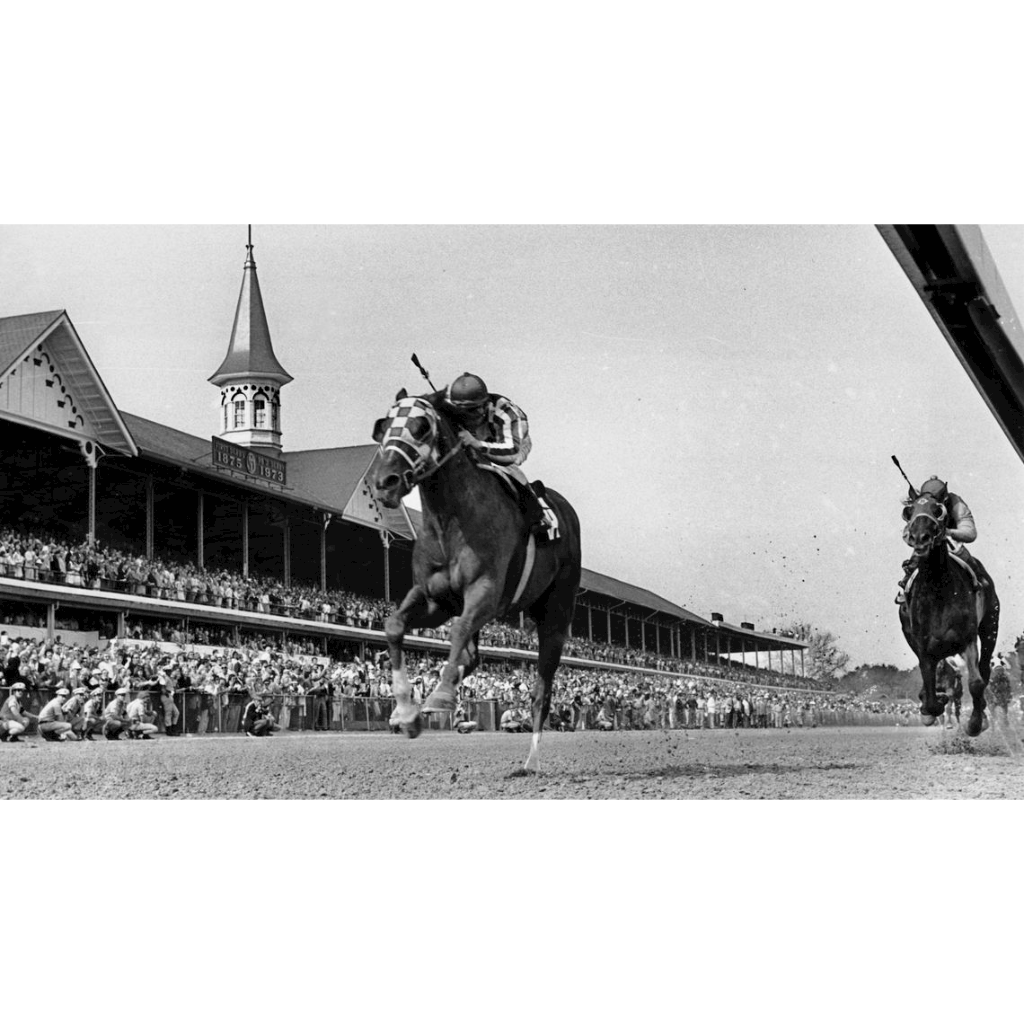
Before we move on to the next race, there is one more thing that needs to be said about Secretariat's impressive Derby win. In most races, the horses begin to tire as the race goes on and that shows up in the times they clock over each quarter mile. In the homestretch, even though they are running as hard as they can, their times are usually slower than in the earlier quarter miles. In Secretariat's Derby run, though, each quarter mile was run faster than the quarter mile before it, meaning that he ran faster in the homestretch than in any other part of the race. To put it another way, he finished the race with lots of gas still in the tank.
This was the talk of the racing world, of course, and the implications of this were not lost on Ron Turcotte. What he learned from this may be responsible for how he ran his next two races. The general public already believed that Secretariat could not be beaten, but what did they know? More importantly, Ron Turcotte was beginning to believe.
The next race, the second leg of the Triple Crown, was the Preakness Stakes, which was run at Pimlico Race Course in Baltimore, Maryland. At one and three sixteenths of a mile, the race was slightly longer than the Derby, but not by much. There were only six horses in this race, presumably because everyone expected Secretariat and Sham to take first and second place, leaving only third place available for the other horses.
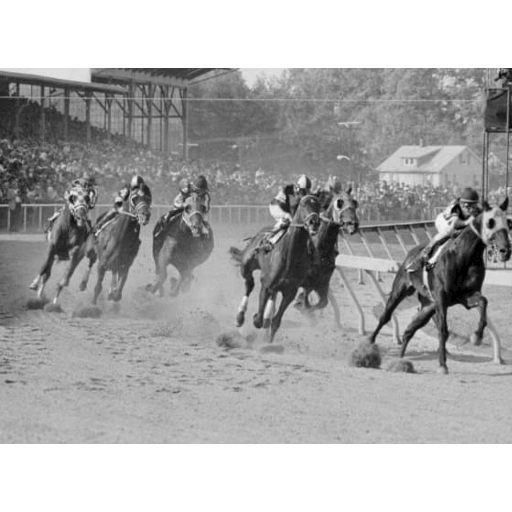
Out of the gate, Secretariat started out in his usual position - dead last. By this time, of course, everyone had come to expect that and were waiting for him to move up slowly but steadily on the outside. But keep in mind that Ron was now a believer in the abilities of his superhorse, so he urged Secretariat to surge forward, passing the entire field in a flash. It was a risky move, but Ron never doubted that the mighty Secretariat could maintain that speed for the rest of the race. Sham moved up to challenge him, but never got closer than two and a half lengths. In fact, that was Secretariat's margin of victory. Sham, once again, finished second.
Secretariat in last place just before making his sudden move in the Preakness
- Full access to our public library
- Save favorite books
- Interact with authors

- < BEGINNING
- END >
-
DOWNLOAD
-
LIKE(3)
-
COMMENT()
-
SHARE
-
SAVE
-
BUY THIS BOOK
(from $11.39+) -
BUY THIS BOOK
(from $11.39+) - DOWNLOAD
- LIKE (3)
- COMMENT ()
- SHARE
- SAVE
- Report
-
BUY
-
LIKE(3)
-
COMMENT()
-
SHARE
- Excessive Violence
- Harassment
- Offensive Pictures
- Spelling & Grammar Errors
- Unfinished
- Other Problem






COMMENTS
Click 'X' to report any negative comments. Thanks!