
What is the Periodic Table of Elements?
The periodic table is an organized representation that displays all of the chemical elements. It is commonly seen as the icon of chemistry.
Role of Protons
A proton is a subatomic particle that is inside the nucleus of an atom. It has a positive electrical charge. The role of a proton is to identify an element. The amount of protons is equal to an element's atomic number. The elements are listed in their atomic numbers least to greatest.
Groups & Periods on the Periodic Table
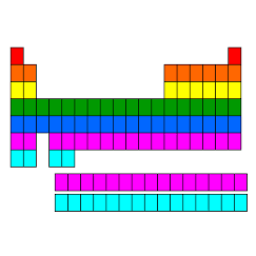
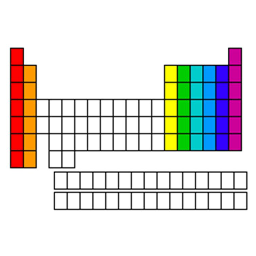
The Periodic table is further organized into groups and periods. Elements in the same group share similar properties and have the same number of valence electrons. Elements in the same period have the same number of energy shells.
Groups are organized vertically.
Periods are organized horizontally.
Elemental Properties on the Periodic Table
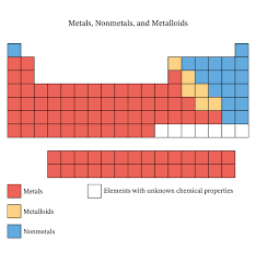
Metals
Nonmetals
Metalloids
The characteristics of metals are luster (shiny), malleable (ability to be hammered down), ductile (ability to be wired), and good conductors of heat and electricity.
The characteristics of nonmetals are dull, brittle (break easily), and poor conductors of heat and electricity.
Metalloids posses characteristics from both metals and non-metals and are semi-conductors.
Valence Electrons
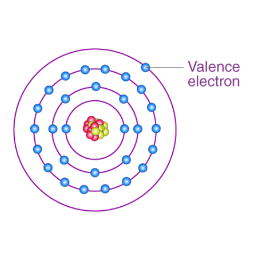
Valence electrons are the electrons on the outermost shell of an atom and determine an element's reactivity. If an element has 8 valence electrons, it is non-reactive, but if it has 1-7 valence electrons it is reactive. Elements with 1 or 7 valence electrons are the most reactive. Elements in the same group have the same amount of valence electrons. As you move from the left to the right, the number of valence electrons increases.
Families on the Periodic Table
On the periodic table, the elements are grouped into families depending on their different properties. The family names are:
Alkali Metals
Alkaline Earth Metals
Transition Metals
Boron Family
Carbon Family
Nitrogen Family
Oxygen Family
Halogens
Noble Gases
Alkali Metals
Physical Properties: Alkali Metals are lustrous, malleable, ductile, and good conductors of heat and electricity.
Chemical Properties: Alkali Metals are highly reactive because they have one electron.
Examples: Hydrogen, Lithium, Sodium, & Potassium
Bohr Models:
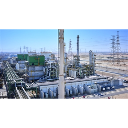
Everyday Uses: Hydrogen is used in petroleum refining and fertilizer production which is a part of the transportation and utility markets. Hydrogen can be used to fuel cells to generate electricity and heat. Sodium is used as a heat exchanger in some nuclear reactors and is in the compound sodium chloride which is commonly used in many different foods and to de-ice roads.



Alkaline Earth Metals


Physical Properties: Alkaline earth metals are lustrous, malleable, ductile, and good conductors of heat and energy.
Chemical Properties: Alkaline earth metals have a high reactivity because they have two electrons.
Examples: Beryllium, Magnesium, Calcium
Bohr Models:
Everyday Uses: Magnesium is used in products that benefit from being lightweight, such as car seats, luggage, laptops, cameras, and power tools. It also ignites easily in the air and burns with a bright light, so it's used in flares, fireworks, and sparklers. Calcium can be used to build and maintain healthy bones and manage blood pressure.




Transition Metals

Physical Properties: Transition metals are lustrous, malleable, ductile, and good conductors of heat and electricity.
Chemical Properties: Transition metals have a lower reactivity and some are non-reactive.
Examples: Tungsten, Platinum, Gold, & Silver
Bohr Models:
Everyday Uses: Iron is utilized in the construction and manufacturing industries. Titanium is used in aircraft construction, artificial hip replacements, and piping for nuclear power plants.

- Full access to our public library
- Save favorite books
- Interact with authors
- < BEGINNING
- END >
-
DOWNLOAD
-
LIKE
-
COMMENT()
-
SHARE
-
SAVE
-
BUY THIS BOOK
(from $2.99+) -
BUY THIS BOOK
(from $2.99+) - DOWNLOAD
- LIKE
- COMMENT ()
- SHARE
- SAVE
- Report
-
BUY
-
LIKE
-
COMMENT()
-
SHARE
- Excessive Violence
- Harassment
- Offensive Pictures
- Spelling & Grammar Errors
- Unfinished
- Other Problem






COMMENTS
Click 'X' to report any negative comments. Thanks!