


To my awesome teacher Mrs.Thompson!
(hi mrs.Thompson)

The Periodic Table
Table of Contents:
I: Introduction to the Periodic Table
II: Protons and Valence Electrons.
III: Three Basic Families.
IV: More Than Basic Families (and their properties)
V: The Periodic Table (now catigorized)
VI:Bohr's Model and the Elements Uses.
I: Introduction to the Periodic Table
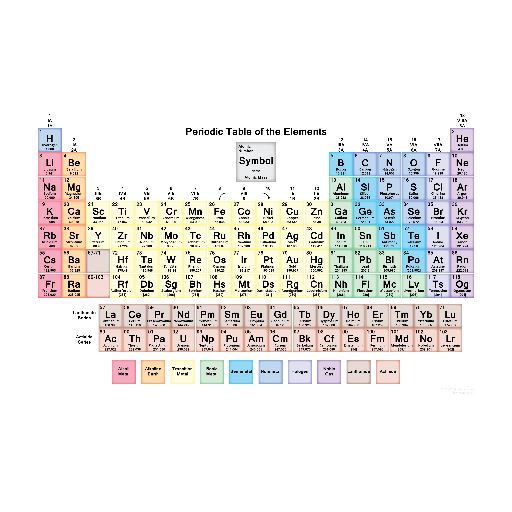
In simple words, the Periodic Table is elements that some people discovered and organized. They have shells of electrons and a nucleus with protons and
Neutrons. Electrons have a negative charge and protons have a positive charge. This causes the electrons and the protons to be the same number to be a stable element. The number of protons will be the atomic number, the number on the top left of an element.
II: Protons and Valence Electrons
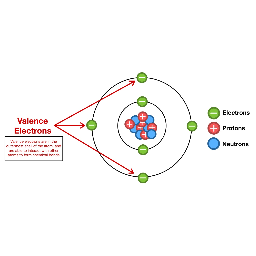
Protons are these things inside the nucleus which determine an element. The number of protons is also the atomic number and the atomic number is what places it on the periodic table. They are placed in numerical order of atomic number in rows or "periods". Now, protons have a positive charge meaning if there were only protons in an atom, it would be unstable. To even it out, there are electrons! Electrons have a negative charge but, there's a limit on how many electrons can go on an atom. Well, not necessarily, to make sure there's room for every element to function properly, we have shells on them. The shells are outside of the nucleus in a circle shape around it and they hold electrons. The ones on the outer (last) shell are called valence electrons. The number of shells is what determines a period. The ones with a similar number of electrons will have a similar number of shells, meaning they'll be in the same period. Every period is correspondent to its number of shells (Ex: Li, 1 valence electron, one outer shell and one inner shell, it's in period 2.
III: Three Basic Families
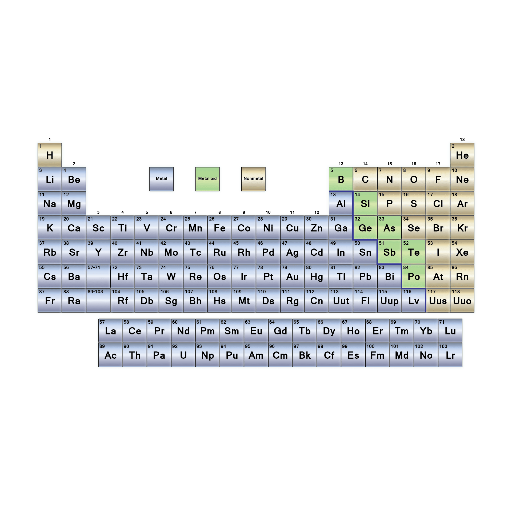
It's pretty simple! The three basic families apart of the periodic table are metals, nonmetals and metalloids. They all have similar properties to the others that are in their family. Metals, for example, are shiny, ductile, and malleable. Nonmetals, however, are the opposite. They are brittle, dull, and non malleable. Metalloids are in the middle, having properties of both families and are located on the "staircase" of the periodic table, essentially splitting up the families with metals (mostly) on the left and nonmetals on the right.
IV: More than three basic families?
(And their properties)
The truth is, it's really not that simple. The periodic table has more than 3 families. It has 8 different families with all different properties. The families are, Alkali Metals, Alkaline Earth Metals, Boron Family, Carbon Family, Halogens, Nitrogen Family, Noble Gases, Oxygen Family, and Transition Metals.
Alkaline Metals: 6 elements, all good conductors and malleable, highly reactive.
Alkaline Earth Metals: Similar to the first, 6 elements, highly metallic and good conductors of electricity. Also malleable and not acidic.
Boron: 5 elements, all have 3 valence electrons and one single metalloid (Boron). Can very much vary in characteristics however, all are flammable and ductile.
Carbon: 6 elements, 1 metal, 2 nonmetals and 2 metalloids. They all vary in physical and chemical properties, the only pure one if found in nature is Carbon.
Halogens: 6 elements, is highly reactive and toxic. Combines with metals to create salt, making a physical and chemical change.
Nitrogen Family: 5 elements, all vary in physical and chemical properties. Becomes more metalliac down the group.
Noble Gases: 7, non reactive, all are gasses and ductile. They can change when reacting to different things, it depends on if they're able to make a compound.
Oxygen Family: 6 elements with one metalloid. It's found outside and is colorless, oderless and tasteless. They are not flammable and are somewhat reactive, needing only 2 more electrons to be stable.
Transition Metals: Lots. Of. Elements. All metals and conductors of electricity and heat. Although not flammable, it will burn. They are shiny and malleable.
V: The Periodic Table
(Now Catigorized)
The first group is the Alkaline metals, they are the most reactive and are good conductors, also metals. The second is Alkaline Earth Metals, almost the same thing as Alkaline metals and are right next to them to the right, slightly less reactive. The third is transition metals, all metals and the highest amount of elements in any group. Fourth is the Boron Family, with the single metalloid representing their group as Boron, they are ductile and flammable. The fifth is the Carbon family, with a very diverse group. They have 2 metalloids, 2 metals and 1 nonmetal and because of this, they all vary in properties. They're all somewhat reactive, needing or giving away four more valence electrons to be stable. Sixth is the Nitrogen Family, with 2 metalloids and 3 nonmetals, they're more ductile and are reactive. Seventh is the Oxygen family, more reactive than the last, full of nonmetal and are ductile and nonflammable. Eighth is the Halogens. Other than the Alkaline metals these are the most reactive. They are almost the same as the others to them on the left except heavier and similarly, non flammable gasses. Last but not least, the noble gasses. They are not reactive at all, however, they are similar in every other way to the other non metals on the left of it.
- Full access to our public library
- Save favorite books
- Interact with authors
- < BEGINNING
- END >
-
DOWNLOAD
-
LIKE
-
COMMENT()
-
SHARE
-
SAVE
-
BUY THIS BOOK
(from $2.99+) -
BUY THIS BOOK
(from $2.99+) - DOWNLOAD
- LIKE
- COMMENT ()
- SHARE
- SAVE
- Report
-
BUY
-
LIKE
-
COMMENT()
-
SHARE
- Excessive Violence
- Harassment
- Offensive Pictures
- Spelling & Grammar Errors
- Unfinished
- Other Problem






COMMENTS
Click 'X' to report any negative comments. Thanks!