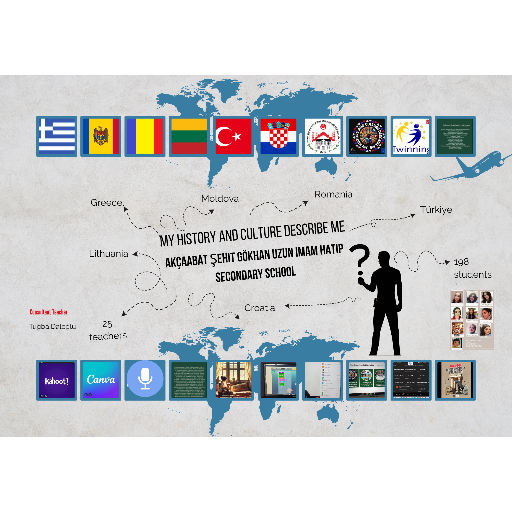
This book was prepared to introduce the project with Tuğba DALOĞLU and a group of 10 students.

Created & published on StoryJumper™ ©2026 StoryJumper, Inc.
All rights reserved. Sources: storyjumper.com/attribution
Preview audio:
storyj.mp/akfzured8a7

Our project aims to enable students to discover and understand their own historical and cultural heritage and to share this heritage with their peers from different cultures, thus building bridges of intercultural understanding, respect and friendship. The project aims to help students express themselves better and gain a global perspective by recognizing historical and cultural elements that are part of their identities.
Project Goals:
1.Developing Personal and National Identity Awareness:
.To ensure that students research their own family history, local traditions, important historical events and cultural elements of the region they live in (food, music, dance, art, clothing, festivals, oral traditions, etc.)..To encourage them to learn about and value their own national history and cultural heritage.
1.Developing Personal and National Identity Awareness:
.To ensure that students research their own family history, local traditions, important historical events and cultural elements of the region they live in (food, music, dance, art, clothing, festivals, oral traditions, etc.)..To encourage them to learn about and value their own national history and cultural heritage.
2
.To ensure that they realize the role of historical and cultural heritage in the formation of personal identity.
2.Increasing Intercultural Awareness and Dialogue:
.To ensure that they learn about the historical and cultural richness of the 7 participating countries (important figures, historical places, cultural practices, legends, etc.).
.To develop empathy skills by discovering similarities and differences between different cultures.
.To teach them to respect cultural diversity and see this diversity as a wealth.
To create an environment of interaction and cooperation between students from different countries and to pave the way for lasting friendships.
.To ensure that they learn about the historical and cultural richness of the 7 participating countries (important figures, historical places, cultural practices, legends, etc.).
.To develop empathy skills by discovering similarities and differences between different cultures.
.To teach them to respect cultural diversity and see this diversity as a wealth.
To create an environment of interaction and cooperation between students from different countries and to pave the way for lasting friendships.
3
3.Developing Communication and Language Skills:
.To provide them with the opportunity to practice their foreign language skills during project activities .
.To develop their skills in effectively expressing their feelings and thoughts using different communication tools (written, verbal, visual).
.To ensure that they learn the rules of courtesy and effective communication strategies that should be considered when communicating with people from different cultures.
.To provide them with the opportunity to practice their foreign language skills during project activities .
.To develop their skills in effectively expressing their feelings and thoughts using different communication tools (written, verbal, visual).
.To ensure that they learn the rules of courtesy and effective communication strategies that should be considered when communicating with people from different cultures.
4
4.Increasing Research and Digital Competencies:
.Developing the skills to collect, analyze and synthesize information from reliable sources about historical and cultural issues.
.Ensuring that they use various web 2.0 tools (presentation programs, video editors, collaborative platforms, virtual boards, etc.) effectively to carry out and present project work.
.Encouraging them to learn responsible and communication rules (netiquette) in the digital environment.
.Developing the skills to collect, analyze and synthesize information from reliable sources about historical and cultural issues.
.Ensuring that they use various web 2.0 tools (presentation programs, video editors, collaborative platforms, virtual boards, etc.) effectively to carry out and present project work.
.Encouraging them to learn responsible and communication rules (netiquette) in the digital environment.
5
5. Supporting Creativity and Collaboration Skills:
Encouraging them to transform the information they learn and the experiences they gain into creative products (presentations, videos, e-books, virtual exhibitions, shared stories, lullabies, games, etc.)
.Developing their skills to cooperate, take responsibility, exchange ideas and make joint decisions by working in mixed-country teams.
Encouraging them to transform the information they learn and the experiences they gain into creative products (presentations, videos, e-books, virtual exhibitions, shared stories, lullabies, games, etc.)
.Developing their skills to cooperate, take responsibility, exchange ideas and make joint decisions by working in mixed-country teams.
6. Strengthening the Awareness of Common Values:
.Emphasizing the importance of shared universal values (peace, friendship, respect, understanding, etc.) despite differences.
6
As my history and describe me partners, we carried out our annual work as follows. In October, a coding study was carried out during the EU Code Week. In November, we worked on the questions How does our culture and history reflect us? What is the most important feature of our region? We created a common word cloud by collaborating. Our students prepared posters and wrote slogans about iconic buildings.
7
In December, they prepared a cookbook and new year's cards by collaborating. In January, they carried out a museum visit, a joint storybook writing, and the introduction of traditional clothes. In February, they carried out a Safe Internet Day and a lullaby reflecting culture. In March, they worked on March traditions in countries, World Water Day, and Women's Day. In April, they shot a video introducing traditional games and prepared a survey. In May, e-twinning day and a farewell meeting were held.
8
October:
Our students had the opportunity to play fun games by coding with the game called Journey to the Planets.
activity code:cw24-8b2XE
Our students had the opportunity to play fun games by coding with the game called Journey to the Planets.
activity code:cw24-8b2XE
.We have announced the coding week on our school page. Come on kids! For Codeweek Code Week, we are doing a coding activity called Journey to the Planets on Eba. We invite all our students to do the coding activity on http://mobilkod.eba.gov.tr/
9
Benefits:
- Full access to our public library
- Save favorite books
- Interact with authors
READ
storyjumper.com
- < BEGINNING
- END >
-
DOWNLOAD
-
LIKE
-
COMMENT()
-
SHARE
-
SAVE
BUY THIS BOOK (from $2.99+)
-
BUY THIS BOOK
(from $2.99+) -
BUY THIS BOOK
(from $2.99+) - DOWNLOAD
- LIKE
- COMMENT ()
- SHARE
- SAVE
- Report
Liked By
X
Encourage this author
-
BUY
-
LIKE
-
COMMENT()
-
SHARE
Problem with this book
X
- Excessive Violence
- Harassment
- Offensive Pictures
- Spelling & Grammar Errors
- Unfinished
- Other Problem
Which pages have problems?
Please describe the problem:
left text
right text
"e Twinning"
A comprehensive project report detailing an international educational initiative to foster intercultural understanding through history, cultural heritage, and collaborative digital activities among students from seven countries.
(15 pages)
Privacy level:
PUBLIC
6 reads
Report





COMMENTS
Click 'X' to report any negative comments. Thanks!