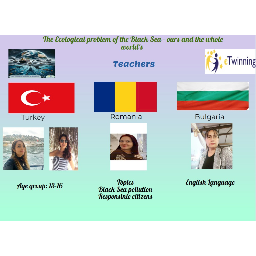
Teachers:
Sema Alieva - Bulgaria
Alina Bulgariu - Romania
Ayşe Köseoğlu - Türkiye
Hayriye Gür - Türkiye

The Black Sea is an inland sea between Southeast Europe and Asia Minor. Recent research shows that Black sea is one of the most polluted seas with plastic and waste in the world. In the seas, as well as on the seabed, huge dumps are gradually formed, outlined by the sea currents closed in a circle. Man-made Litter is a growing threat to marine habitats and creates serious environmental, economic and health problems risks.
The majority of solid waste in the marine environment consists of materials that degrade very slowly and therefore the constant increase in the amount of waste that reaches the seas and oceans leads to their accumulation in the marine environment and along the coast. This negative trend is confirmed by a number of studies in various regions that clearly indicate that the marine litter situation is worsening in world Wide. The seas and oceans are fundamental to the well-being and well-being of people - they are trade routes, climate regulator, sources of food, energy and resources and a preferred place to stay and recreation by vacationers and tourists.
The ecological problem of the Black Sea is not only a problem of the countries located around it, but of all countries related to pollution and. Large rivers flow into the Black Sea, which also pollute the waters and. Danube River passes through 10 countries before flowing into the Black Sea. Through the Bosphorus and the Dardanelles the polluted waters ass into the Mediterranean Sea and from there into the oceans. Does this problem affect everyone who lives on the coast or away from it? To what extent are people informed about the state of the waters of the seas and oceans and what are their consequences? How we should change our habits and protect the waters of the seas clean?
The inclusion of students in studies on the ecological state of the Black Sea and the implementation at informational meetings with the community, will give publicity and people will realize the need to change the your habits.
What is climate change?
Climate change is an immediate threat to our world. But we can all do something to help prevent it and build a better future.
Global Warming
The years 2011 to 2020 are the warmest decade on record, with the 2019 global average temperature reaching 1.1°C above pre-industrial levels! Human-caused global warming is currently increasing at 0.2 °C per decade.
A temperature increase of 2 °C, compared to the temperature during the pre-industrial period, would lead to serious negative impacts on the natural environment and human health and well-being, including a much higher risk of dangerous and potentially catastrophic changes in the environment.
Causes of climate change
Burning fossil fuels, cutting down forests and raising livestock are increasingly affecting the Earth's climate and temperature.
This adds huge amounts of greenhouse gases to those released naturally into the atmosphere, increasing the greenhouse effect and global warming.
Greenhouse gases
The main driver of climate change is the greenhouse effect. Certain gases in the Earth's atmosphere act somewhat like glass in a greenhouse, trapping the sun's heat and stopping it from returning to space, causing global warming.
Many of these greenhouse gases exist naturally, but human activities lead to an increase in the concentration of some of them in the atmosphere, in particular: carbon dioxide (CO 2 ), methane, nitrous oxide, fluorine-containing gases
Marine pollution can affect climate change through several mechanisms:
Heat absorption: Oceans absorb much of the heat emitted by the sun. Pollutants such as oil and plastics that end up in the oceans can increase heat absorption and raise water temperatures. This can contribute to the acceleration of global warming processes.
Greenhouse gas emissions: Some pollutants, such as plastic waste and decomposing organic matter, can produce greenhouse gases when they break down in the oceans. These gases, such as methane and carbon dioxide, can amplify the effect of the greenhouse gas effect and contribute to global warming.
Impact on ecosystems: Marine pollution can affect the health of marine ecosystems, including coral reefs and marine aquatic species. Disruption of these ecosystems can have long-term consequences for the ocean's carbon sink and climate regulation.
Impact on ocean currents and circulation: Marine pollution can affect ocean currents and circulation, which play an important role in regulating climate by distributing heat across the world's oceans. Disruption of these currents can have long-term consequences for the climate.
So, marine pollution can amplify the effects of global warming and affect the planet's climate systems.
Ocean currents and circulation play a critical role in regulating Earth's climate. Marine pollution can have the following effects on these currents and circulation:
Change in water salinity and temperature: Marine pollution can change the salinity and temperature of seawater. This can affect the density of the water and therefore the ocean currents.
Blocking or altering currents: Debris such as plastics or tree parts can block marine currents or change their path. This can change the general flow regime and have an impact on the climate of near and far regions.
Impact on marine ecosystems: Pollution can destroy or disrupt marine ecosystems that play a key role in marine circulation.
Impact of ocean currents by climate change: Climate change can alter the intensity and path of ocean currents. Pollution of the seas can amplify these impacts, for example by accelerating the melting of ice and changing the salinity of the water.
The absorption of heat by the oceans is an important process that plays a key role in regulating Earth's climate. The oceans absorb much of the solar heat that hits them, a process that has several important consequences:
Temperature regulation: Oceans act as large reservoirs of heat, absorbing and storing much of the sun's heat. This helps maintain a relatively stable temperature on Earth's surface, limiting extreme fluctuations in climate.
Climate change mitigation: Oceans play an important role in absorbing excess heat from the atmosphere, which can help mitigate the effects of global warming. The absorption of heat by the oceans prevents them from heating up quickly and traps some of the heat in the deep seas.
Influence on climate phenomena: The oceans are also involved in the regulation of climate phenomena such as El Niño and La Niña. The absorption of heat by the oceans can influence the temperature differences in the water and modulate the intensity of these phenomena.
- Full access to our public library
- Save favorite books
- Interact with authors
- < BEGINNING
- END >
-
DOWNLOAD
-
LIKE
-
COMMENT()
-
SHARE
-
SAVE
-
BUY THIS BOOK
(from $6.79+) -
BUY THIS BOOK
(from $6.79+) - DOWNLOAD
- LIKE
- COMMENT ()
- SHARE
- SAVE
- Report
-
BUY
-
LIKE
-
COMMENT()
-
SHARE
- Excessive Violence
- Harassment
- Offensive Pictures
- Spelling & Grammar Errors
- Unfinished
- Other Problem





COMMENTS
Click 'X' to report any negative comments. Thanks!