This book is dedicated to all the learners who remind me daily of the joy and purpose found in teaching. Your curiosity, resilience, and enthusiasm inspire me to grow, reflect, and strive to become the best educator I can be.
To my mentors, colleagues, and peers, thank you for your guidance, encouragement, and wisdom throughout my teaching journey. You have helped shape not only my professional identity but also my passion for lifelong learning.
Most importantly, I dedicate this work to the teaching profession itself, a calling that challenges, transforms, and uplifts. May this log serve as a reflection of my growth, values, and commitment to creating meaningful learning experiences for every learner I teach.


MY TEACHING PHILOSOPHY
Teaching, in my opinion, is a process that fosters curiosity, critical thinking, and the development of responsible citizens in addition to imparting knowledge. In my opinion, effective instruction should be learner-centred, including students as active creators of their own knowledge rather than passive consumers of it. It is the responsibility of the educator to support, encourage, and promote learning through relevant experiences that relate what is learnt in the classroom to real-life scenarios.
I believe that when learners are actively engaged in the learning process, they learn the most. Collaborative, participatory, and hands-on learning are ideal. Learners gain a more comprehensive understanding of the material when they investigate ideas through experimentation, discussion, and discovery. In mathematics, for instance, students might make abstract concepts easier to understand by using tangible materials or group-based problem-solving exercises. This approach adheres to constructivist concepts, which hold that knowledge is constructed by students using their prior knowledge and understanding.
Additionally, teaching ought to encourage diversity and inclusiveness. Every learner is diverse, with varying backgrounds, learning methods, and skill levels. To guarantee that no learner is left behind, lessons should be created to accommodate auditory, visual, and kinaesthetic learners. By offering a variety of instructional strategies, including technological integration, narrative, hands-on activities, and visual aids, students can engage with the material in ways that best suit them.
Another essential component of my philosophy is creating a classroom atmosphere that is encouraging and helpful. When they feel appreciated, safe, and respected, learners flourish. I support creating an environment in the classroom where people respect one another, work together, and support one another. It is important to view mistakes as teaching moments that help students become more resilient and confident in themselves.
Moreover, I view assessment as an ongoing process that informs both teaching and learning.
Peer evaluations, group projects, and class discussions are examples of formative assessments that enable me to track student development and adjust my teaching techniques as required. On the other hand, summative assessments provide students the chance to demonstrate what they have achieved. Giving constructive criticism is crucial for assisting students in reflecting on their educational experiences and establishing goals for growth.
My ultimate stance is that education should prepare learners for life, not only for tests. Students should be urged to collaborate, think critically, and find innovative solutions to problems. They should leave school with the knowledge, principles, and mindsets necessary to make a significant contribution to their communities. My goal is to help students develop a passion for learning that goes beyond the classroom and equips them to think critically on their own and pursue lifelong learning.
CLASSROOM MANAGEMENT
Theoretical Justification
The selected classroom management tool is Bouncy Balls integrated with a Group Points System which is grounded in both Behaviourist and Constructivist learning theories. From a Behaviourist perspective, this tool reinforces positive behaviour through visual and auditory feedback. According to B.F. Skinner’s Operant Conditioning theory, desired behaviours can be strengthened through positive reinforcement. In this case, the visual feedback (bouncing balls increasing or decreasing) and group points serve as reinforcement cues that encourage learners to regulate their own noise levels and cooperate as a team. When the class maintains a calm noise level, they earn focus points and verbal praise, motivating them to repeat this positive behaviour.
The Constructivist theory, influenced by Lev Vygotsky, also supports the use of this tool. Constructivism suggests that learners build understanding through active engagement and social interaction. The group point system fosters collaboration, peer accountability, and shared responsibility. Learners reflect on their behaviour collectively, discuss how to improve teamwork, and develop social-emotional skills such as self-control, empathy, and communication.
Additionally, the Social Learning Theory proposed by Albert Bandura underpins this practice. Learners observe the reactions of others and model appropriate behaviours. When one group demonstrates self-discipline and earns points, other groups are likely to imitate this positive conduct to gain similar rewards. Therefore, the tool not only manages behaviour but also shapes it through observation, imitation, and reinforcement. Overall, the Bouncy Balls with Group Points System combines digital engagement, teamwork, and motivation which is all supported by well-established educational theories that emphasise behaviour shaping, active participation, and social collaboration.
Description and Use of the Tool
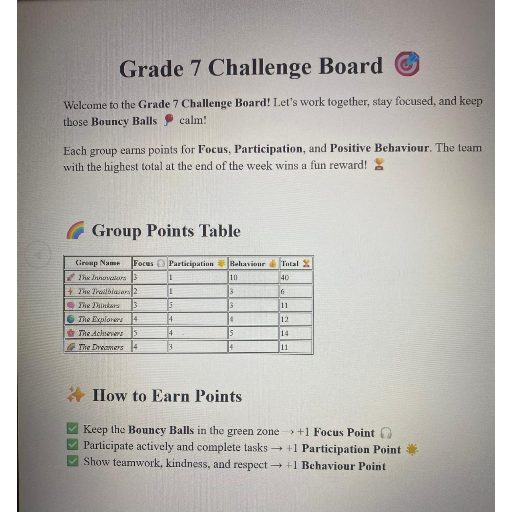
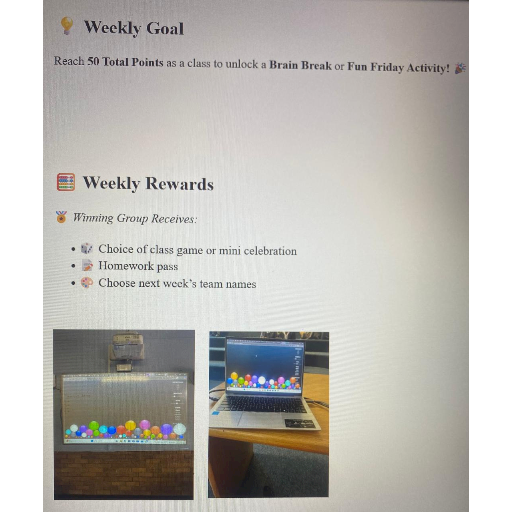
The Bouncy Balls tool is an online visual sound monitor that uses the classroom microphone to track noise levels. The balls bounce higher as the noise increases and settle when the class becomes quieter. The tool is projected onto the SmartBoard for all learners to see, turning noise control into an engaging, real-time visual experience. This tool is paired with a Digital Group Points Board, which displays six groups. Each group earns points under three categories which include Focus, Participation, and Behaviour. When the Bouncy Balls stay in the green zone (quiet mode), each group earns a Focus Point. When learners work collaboratively and complete tasks efficiently, they earn Participation Points, and when they show respect, teamwork, and responsibility, they earn Behaviour Points. At the end of each week, the group with the highest total points receives a small reward such as a homework pass, a short class game, or choosing the Friday activity. This system keeps learners motivated while reinforcing positive conduct and accountability.
Reflection on Successes and Vulnerabilities
Successes
The implementation of the Bouncy Balls tool was highly effective in promoting self-regulation and team collaboration. Learners were visibly motivated to keep the “balls steady” and took ownership of their behaviour. The integration of a fun digital element captured learners’ attention and reduced the need for constant verbal reminders. The group points system encouraged healthy competition, peer support, and collective responsibility, aligning with a positive classroom climate. The visual aspect helped auditory and visual learners understand classroom expectations more clearly.
Vulnerabilities
Despite its success, a few challenges emerged. The tool depends on stable internet connectivity and a functioning microphone, which can sometimes be unreliable in a rural or resource-limited context. Learners could also become overly focused on the game-like aspect, momentarily losing sight of learning objectives. Additionally, balancing fairness in group point allocation can be challenging, as some groups may perceive bias if points are not consistently justified. Lastly, the system requires continuous teacher monitoring and adaptation to ensure it remains a supportive learning aid rather than a mere control mechanism.
Overall Reflection
The Bouncy Balls and Group Points System proved to be a powerful tool for maintaining order, promoting collaboration, and enhancing learner engagement. Its theoretical grounding in behaviourism and constructivism ensures that it supports both discipline and meaningful learning. While technical and motivational challenges exist, the benefits outweigh the limitations when the tool is used thoughtfully and consistently.
MY CV
CV Link:
https://www.canva.com/design/DAG1yDwlVUg/k2wu-3b2LVMNYqV1Tb7PVA/view?utm_content=DAG1yDwlVUg&utm_campaign=designshare&utm_medium=link2&utm_source=uniquelinks&utlId=h034f1c15f3
LinkedIn Link:
https://www.linkedin.com/in/thandeka-ngwenya-0a1b18376/

- Full access to our public library
- Save favorite books
- Interact with authors
- < BEGINNING
- END >
-
DOWNLOAD
-
LIKE
-
COMMENT()
-
SHARE
-
SAVE
-
BUY THIS BOOK
(from $3.39+) -
BUY THIS BOOK
(from $3.39+) - DOWNLOAD
- LIKE
- COMMENT ()
- SHARE
- SAVE
- Report
-
BUY
-
LIKE
-
COMMENT()
-
SHARE
- Excessive Violence
- Harassment
- Offensive Pictures
- Spelling & Grammar Errors
- Unfinished
- Other Problem






COMMENTS
Click 'X' to report any negative comments. Thanks!