Introduction
What Is Biodiversity
Why Biodiversity Matters
Life Below Water
Life on Land
Species Pages (one per student)
Glossary
Reference

Biodiversity is the incredible variety of life on Earth — from tiny microorganisms to vast forests and deep oceans. It includes the diversity of species, ecosystems, and even the genetic differences within each species. Biodiversity has ecological, genetic, social, economic, scientific, educational, cultural, and aesthetic value, and it plays a critical role in maintaining healthy ecosystems that support human well‑being
We study biodiversity because it is the foundation of life. It provides us with . Nearly half of the world’s population depends directly on natural resources for daily survival, and many communities rely on biodiversity for their livelihoods. Protecting it means protecting ourselves.
This Mini Encyclopedia was created through the collaboration of students from different countries. Each student explored a species from their region, shared cultural perspectives, and contributed a unique page to this book. Together, their work reflects the idea that nature connects us across borders, and that caring for the planet is a shared responsibility.
Our project is closely linked to two important global goals:
This goal focuses on protecting oceans, seas, and marine resources. Marine ecosystems are essential for food security, climate balance, and biodiversity, yet they are threatened by pollution, overfishing, and climate change.
This goal aims to protect and restore forests, stop desertification, and halt biodiversity loss. Healthy terrestrial ecosystems provide raw materials, regulate climate, maintain soil quality, and support life on Earth.
By learning about biodiversity and endangered species, we take the first step toward becoming guardians of our planet. This encyclopedia is our collective voice — a promise to protect the world we share.
Biodiversity means the variety of life on Earth. It includes all living things — animals, plants, fungi, and even tiny microorganisms like bacteria. These organisms live in ecosystems and work together like a giant web to keep nature balanced and healthy.
Biodiversity exists at three levels:
Genetic diversity – differences within the same species (like different types of apples or dogs)
Species diversity – the number of different species (like birds, fish, trees)
Ecosystem diversity – the variety of habitats (like forests, oceans, deserts)
Provides food, oxygen, medicine
Keeps ecosystems balanced
Protects climate
Supports human life
Each student creates ONE page about a chosen species.
:Species Name (Common + Scientific)
Habitat: Where it lives
Category: Life Below Water / Life on Land
Conservation Status: (Least Concern, Vulnerable, Endangered, Critically Endangered)
Threats: Pollution, climate change, habitat loss, poaching, etc.
Why It Matters: Its role in the ecosystem
Life Below Water:
Sea turtle
Blue whale
Coral
Seahorse
Clownfish
Great white shark
Octopus
Life on Land:
Red panda
Snow leopard
African elephant
Giant panda
Koala
Lynx
European bison
Teacher-Eleonora Burnete
Students-Teodora, Daria, Otilia, Elena, Stefania, Karla, Veronica
Octopus
Scientific name: Octopus vulgaris
Habitat: Oceans worldwide, especially warm tropical waters
Category: Life Below Water
Conservation status: Not officially evaluated (varies by species)
Fun facts:
Has three hearts and blue blood
Can change color to camouflage
Very intelligent — can solve puzzles
If it loses an arm, it can grow it back
Threats: Pollution, overfishing, habitat destruction
Why it matters: Octopuses help control populations of crabs and other sea creatures, keeping the ecosystem balanced.
Octopus vulgaris (common octopus)
Most species are not officially endangered, but some face regional threats. Conservation efforts focus on protecting habitats and reducing ocean pollution.
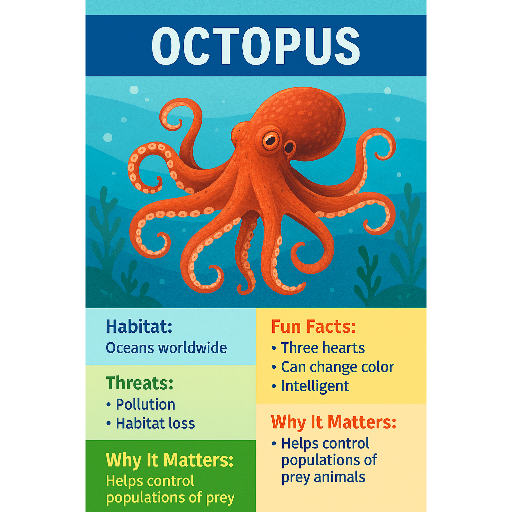
The most common species found in the Black Sea is the Common Octopus (Octopus vulgaris)**. It’s a highly intelligent marine animal known for its ability to camouflage, solve problems, and escape predators.
The Mangalia–Limanu coastal lake is part of marine biodiversity studies and ecosystem assessments
Romanian marine institutes like GeoEcoMar monitor species diversity and environmental health
Eleonora Burnete-teacher
Students-Veronica, Iulia, Daria, Darius, Miruna, Emily
Red panda
Ailurus fulgens
Nepal,India,Bhutan, China, Myanmar.
Even though they are classified as carnivores, red pandas eat mostly bamboo. They also enjoy:
Fruits
Berries
Eggs
Small insects
EDVICA POPA - PROFESOR
ELEVII : FLORENTINA , ALEXANDRU, LUCIAN ,ROBERT, MIHAI
Leopardul ( ) este una dintre cele cinci de feline existente din Panthera rozete Corpul său este subțire și musculos, ajungând la o lungime de 92–183 cm, cu o coadă lungă de 66–102 cm și o înălțime până la umeri de 60–70 cm. Masculii cântăresc de obicei 30,9–72 kg, iar femelele 20,5–43 kg
. Leopardul a fost descrie pentru prima dată în 1758, iar în secolele al XIX-lea și al XX-lea au fost propuse mai multe subspecii . Astăzi, sunt recunoscute opt subspecii în arealul său larg de răspândire din Africa și Asia . Inițial, a evoluat în Africa în timpul Pleistocenului timpuriu , înainte de a migra în Eurasia în jurul tranziției Pleistocenului timpuriu- mijlociu. Leoparzii erau prezenți anterior în toată Europa , dar au dispărut în regiune în jurul sfârșitului Pleistocenului timpului târziu - Holocenul timpului .
Leopardul este adaptat la o varietate de habitate, de la la , inclusiv zone și montane. Este un prădător ungulate primate camuflaj animal solitar maturitatea sexuală
Numele „leopard” provine din cuvântul grecesc leopardus, care este o combinație de leon (leu) și pardus (panteră). Leoparzii sunt feline mari cunoscute pentru corpurile lor cu blană aurie, cu pete și pentru tehnicile de vânătoare grațioase, dar feroce. Deși acoperirea lor este vastă, numărul lor este în scădere. Leoparzii sunt cei mai mici membri ai felinelor mari. Ei cresc de la 92 până la 190 de centimetri lungime. Coada lor adaugă încă 64 până la 99 cm la lungimea lor. Masculii și femelele variază în greutate. Femelele cântăresc de obicei între 21 și 60 de kilograme, iar masculii cântăresc de obicei de la 36 până la 75 kg. Citește toată știrea: Leopardul - curiozități și lucruri surprinzătoare despre aceste feline
ÖĞRETMEN : HATICE AÇIK
ÖĞRENCİLER: SUDE, GÖKTUĞ, NURDABİR, YAKUP, YALÇIN, MUSTAFA ASAF.
KOALA
BLUE WHALE
- Full access to our public library
- Save favorite books
- Interact with authors
- < BEGINNING
- END >
-
DOWNLOAD
-
LIKE
-
COMMENT()
-
SHARE
-
SAVE
-
BUY THIS BOOK
(from $8.99+) -
BUY THIS BOOK
(from $8.99+) - DOWNLOAD
- LIKE
- COMMENT ()
- SHARE
- SAVE
- REMIX
- Report
-
BUY
-
LIKE
-
COMMENT()
-
SHARE
- Excessive Violence
- Harassment
- Offensive Pictures
- Spelling & Grammar Errors
- Unfinished
- Other Problem






COMMENTS
Click 'X' to report any negative comments. Thanks!