This book took way too long...

Basic Information
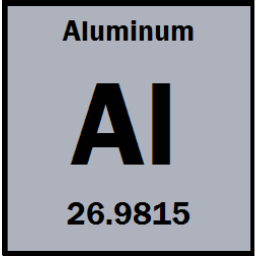
The atomic number is 13 because it has 13 protons
The atomic weight is 26.9815
The atomic sign is Al
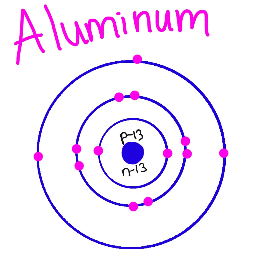
Bohr Model
13 Protons
13 Neutrons
13 Electrons
History
Aluminum was one of the newest metals to be discovered by humans. Aluminum does not occur naturally in its purest form so it was not discovered until the 19th century with developments in chemistry and the advent of electricity. It was discovered by Humphry Davy, an English chemist, who, in 1808, identified that aluminum could be produced by an electrolytic reduction from alumina (aluminum oxide), but did not manage to prove the theory in practice.
Appearance
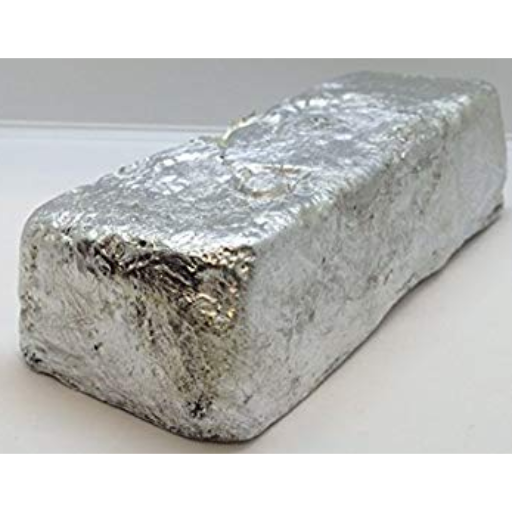
It is shiny and looks like silver but is much lighter, and is solid at room temperature
Abundance
Although aluminum is the most abundant metal in the earth's crust, it is never found free in nature. All of the earth's aluminum has combined with other elements to form compounds. Two of the most common compounds are alum, such as potassium aluminum sulfate (KAl(SO4) 12H2O), and aluminum oxide (Al2O3).
Synthesis
The Aluminum Oxide Ore is first sent through the Bayer Process to create alumina, then the alumina is sent through the Hall-Heroult process to create pure aluminum.
Common uses
Aluminum is used in a huge variety of products including cans, foils, kitchen utensils, window frames, beer kegs and airplane parts.

Health Benefits
Aluminum in food and beverage packaging provides safe barriers to bacteria and contamination
“Alum” (aluminum sulfate) helps purifying drinking water
Aluminium compounds increases immune response in vaccines and medicines

Environmental effects
As you have probably noticed, turning Bauxite (aluminum ore) into Aluminum requires a lot of energy and has a variety of environmental impacts.
Both open and underground mines affect the plant and animal life immediately surrounding an area and beyond for multiple generations. Clear-cutting trees and grasslands contributes to biodiversity loss, habitat loss, carbon emissions, and erosion.
Compounds and their uses
Aluminum potassium sulfate KAl(SO4)2 is one of the more prevalent compounds of aluminum in the earths crust. One of its major uses is in the dyeing of fibers and fabrics, where it is employed as a mordant.
Aluminum Oxide Al2O3 is another common compound of aluminum and Aluminum oxide is used in the ceramic industry as an insulating material.
General Information
There are 3 main particles that make up the atom
The proton, the neutron, and the electron
In the nucleus there are 2 particles, the proton and the neutron.
Outside the nucleus are the electrons
All the electrons are not at a constant distance from the nucleus because they are in mainly elliptical orbits that vary the distance between the apogee and the perigee.
Not all atoms have the same number of protons, the protons are what determine what the atom is, like hydrogen has one proton and aluminum has thirteen.
Reactions
The swapping of electrons are what mainly constitute chemical reactions.
Nuclear reactions release huge amounts of kinetic energy, due to the mass lost in the reaction.
- Full access to our public library
- Save favorite books
- Interact with authors
- < BEGINNING
- END >
-
DOWNLOAD
-
LIKE
-
COMMENT()
-
SHARE
-
SAVE
-
BUY THIS BOOK
(from $3.99+) -
BUY THIS BOOK
(from $3.99+) - DOWNLOAD
- LIKE
- COMMENT ()
- SHARE
- SAVE
- Report
-
BUY
-
LIKE
-
COMMENT()
-
SHARE
- Excessive Violence
- Harassment
- Offensive Pictures
- Spelling & Grammar Errors
- Unfinished
- Other Problem





COMMENTS
Click 'X' to report any negative comments. Thanks!