
RESPIRATION
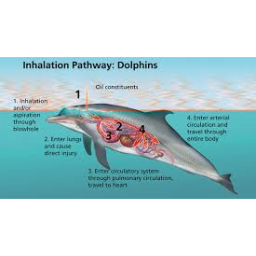
Oxygen molecules enter the lungs through the blowhole and then enter the bloodstream from there. Then, the blood carries the oxygen to all the other cells in the dolphin's body. While being spread through the body, the oxygen molecules combine with glucose. Lastly, the waste products, CO2 and H2O, go back into the bloodstream, and the CO2 goes back into the lungs and leaves the body through the blowhole.
CIRCULATION
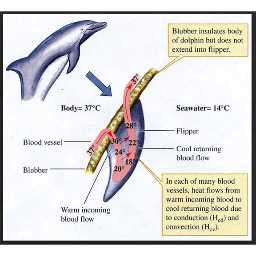
Dolphins have a closed circulatory system. They have veins, blood vessels, and capillaries. Their circulatory system adjusts to maintain a consistent body temperature. When a dolphin needs to cool down, the circulation increases near the fin and flippers and decreases near the body core.
DIGESTION
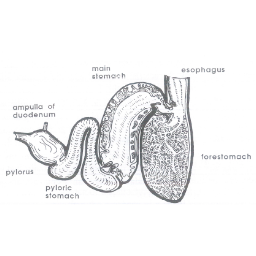
First, dolphins take the food in through the mouth and through the esophagus. Then, it enters the stomach region - dolphins have a three chambered stomach. The first chamber, called the fore stomach, is where most of the mastication happens. Then, in the second or main chamber, the majority of the digestion is processed. Lastly, the third chamber, called the pyloric stomach, is responsible for the remainder of the digestion before the contents empty into the intestines.

NUTRITION
Dolphins are predators, so they rely on other animals for food. Most dolphins eat fish like mackerel or herring, and some eat squids. Large dolphins usually feed on other marine animals like seals, sea lions, and turtles.
FOOD GETTING
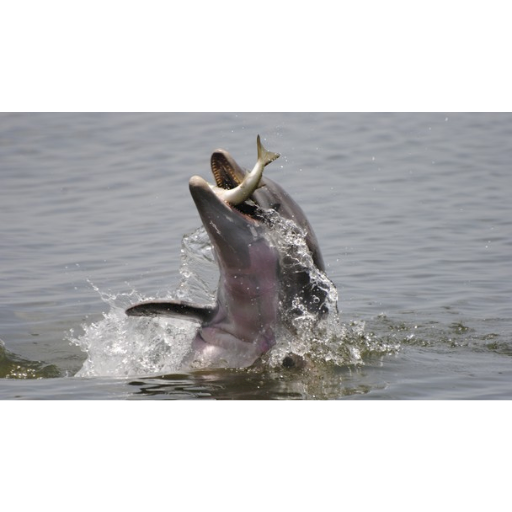
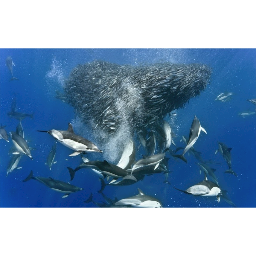
Dolphins hunt in pods, and every pod has different strategies when it comes to food getting. One example is herding. This strategy is when the pod surrounds a big school of fish and pushes in close. This way, the fish have no where else to go but up. Once the fish are pushed up to the surface, the dolphins can get to them easier. Another method is where some dolphins chase the fish into the other dolphins' mouths. When trying to get away, the fish will jump out of the water directly into the dolphins' mouths. They also use their echolocation to search for fish underneath the sand.
SUPPORT
They have an elongated torpedo-like body that allows them to slide through the water easily. Their fins are stiff cartilage with a surrounding layer of muscle. This allows them to control how the water moves around its fins and body. Its skin has adapted to be smoother to allow it to move quickly and change direction easily as the water glides right over it.
PROTECTION
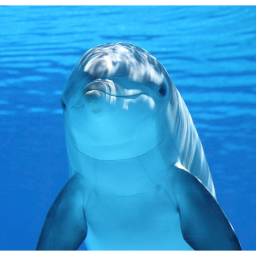
Sharks are a dolphin's only predator. In order to protect itself from a shark, a dolphin can do many things. One thing is a "sucker punch". This is when a dolphin races towards a shark, sips down beneath it, and comes back up to "punch" the shark in its stomach with the dolphin's long snout-like nose. Another adaptation that a dolphin has to help it protect itself is its echolocation. It can use this to sense a shark coming and hide or swim away.
MOVEMENT
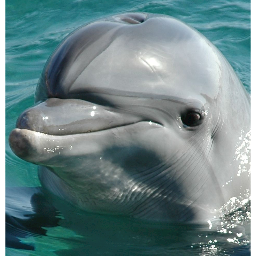
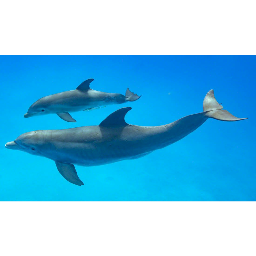
In order to move, dolphins arch their backs and move their flukes up and down to generate and propel water. Also, the dolphin's body shape and smooth sin allows it to glide through the water easily and quickly. They use their flippers to move up and down in the water, and their dorsal fin helps it stay stabilized while swimming.
OSMOTIC REGULATION & EXCRETION
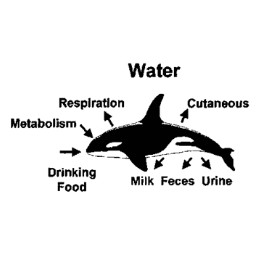
Like all other mammals, dolphins excrete waste through the anus. After the food has gone through the three chambers of the stomach, it is passed into the large intestine, then out through the anus. The ingestion of fresh and salt water and alterations of urine osmolality are what helps a dolphin maintain its water balance.
TEMPERATURE REGULATION
Dolphins are endothermic, meaning they can generate their own heat and maintain stable body temperature. They can also control and maintain their body temperatures in any fluctuating water temperature, which makes them homeothermic.
REPRODUCTION
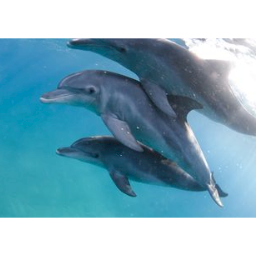
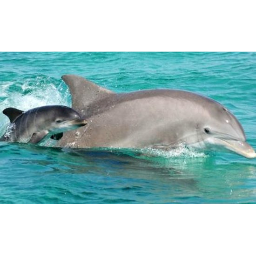
Dolphins, like other mammals, go through sexual reproduction. The mothers are impregnated and go through internal fertilization. Then, they give birth to their young, who stay alongside the mother for about 2-4 years.
DEVELOPMENT
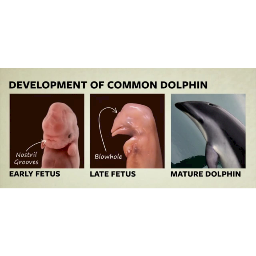
Before being born, dolphins go through a 1 year gestation period 18 months as a suckle. When the dolphin is old enough, it leaves its mother and lives until it is about 45 years old. When in the mother's stomach, a dolphin embryo is a lot like a human. The differences come into play when the tail, flippers, and fin form on a dolphin and the legs and arms form on a human. Dolphins are already born with all of these, so most of the developmental stage is just growth. Another big part of development is the blowhole forming.
MATING BEHAVIORS
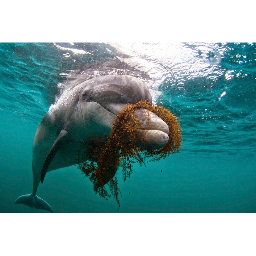
Like most mammals, dolphins find mates through physical interaction like biting or rubbing up against each other. Sometimes, they will also use vocal indicators like clicking. Male dolphins will sometimes give the females a "bouquet" made of seaweed in order to impress them and as a gesture or sign of romanticism.
SENSES
Both the hearing and eyesight of dolphins is very complex and very important in relation to the brain. They are able to hear frequencies 7.5 times wider than humans can. The sounds are taken in by their cone shaped teeth that act as antennas. As for eyesight, dolphins have special muscles in their eyes that allow them to change the shape of the lens so they can see above or below water clearly - whichever is more helpful in their current situation. Their eyes are on the side of their head, so they can process multiple visuals at once.
- Full access to our public library
- Save favorite books
- Interact with authors
- < BEGINNING
- END >
-
DOWNLOAD
-
LIKE
-
COMMENT()
-
SHARE
-
SAVE
-
BUY THIS BOOK
(from $4.59+) -
BUY THIS BOOK
(from $4.59+) - DOWNLOAD
- LIKE
- COMMENT ()
- SHARE
- SAVE
- Report
-
BUY
-
LIKE
-
COMMENT()
-
SHARE
- Excessive Violence
- Harassment
- Offensive Pictures
- Spelling & Grammar Errors
- Unfinished
- Other Problem





COMMENTS
Click 'X' to report any negative comments. Thanks!